Self-improving agentic workflows your organization owns.

People, AI agents, and systems run each process under a released, governed version. Every run leaves a replayable record you own: proof for any audit, and the data your workflows improve on.

Governed workflow canvas: services, AI agents, people, and connectors assembled into a released workflow with a learn and optimize loop.A canvas labeled Your Organization. Icons for databases, APIs, documents, model providers, roles, and messaging tools sit in four connected cards, Services, AI Agents, People, and Connectors, inside a workflow frame stamped with a version and released today, under a green governed badge listing observability, audit logs, and proof. A dashed learn and optimize loop routes the workflow output back to its start, and on load the icons first appear scattered across the canvas before organizing into this workflow.YOUR ORGANIZATIONGOVERNED · OBSERVABILITY · AUDIT LOGS · PROOFWORKFLOW · V1.4RELEASED · 2026-07-22LEARN AND OPTIMIZENEXT: V1.5 · CANDIDATEServicesDatabaseAPIMCPDocumentsAI AgentsAnthropicGPTMistralGLMPeopleAnalystQAReviewerSecurityConnectorsGmailOutlookSlackTeamsGoverned workflow canvas: services, AI agents, people, and connectors assembled into a released workflow with a learn and optimize loop.YOUR ORGANIZATIONGOVERNEDWORKFLOW · V1.4RELEASED · 2026-07-22LEARN AND OPTIMIZENEXT: V1.5 · CANDIDATEServicesDatabaseAPIMCPDocumentsAI AgentsAnthropicGPTMistralGLMPeopleAnalystQAReviewerSecurityConnectorsGmailOutlookSlackTeams
§ 01 · Governance

Governed, observed, audit ready.

Hand critical work to AI and automation, without handing over control, or the proof. You always know the true state of every run, prove it the moment anyone asks, and fix a broken one in minutes, not days.

WORKFLOW · V1.4 · RUN 4022PROD
OBSERVABILITY · TRACES
01

Operational certainty

Every run is visible while it happens: which step is live, which actor holds it, what was just decided. The state of the operation is a fact on screen, not a guess assembled from check-ins.

AUDIT LOG · HASH-CHAINED
02

Evidence for auditors

When DORA, the EU AI Act, or an internal review asks how a decision was made, the recorded evidence already answers: what ran, who approved it, under which released version. Evidence is a lookup, not a scramble.

REPLAY · EVENTS
03

Debugging in minutes

A failed run replays step by step with the exact state it ran under. Root cause stops being detective work, and the fix can be proven against the very run that broke.

§ 02 · Authoring

Plain language is the new builder.

Saying what a process should do is enough. Kora turns that plain description into a versioned definition, ready for release; nobody wires up nodes by hand.

KoraClaudeCodex

What should Kora build?

process-map.bpmn24 KBapprovals-sop.pdf180 KBdata-schema.xlsx41 KB

Turn this BPMN and our SOP docs into a governed workflow.

The shift to plain language is not ours alone.

§ 03 · Optimization

Workflows that improve with every run.

You own the execution data from every run. It shows exactly where operations slow down or break, so you fix the cause and release a faster, cleaner version.

Approval workflow1,240 runs
Request received1,240 runs
Bottleneck

Requests wait 1.4 days for a manager decision.

Auto-approve requests under the set threshold.

Manager approvalavg 1.4d
Compliance check12% fail
Failing

Fails on 1 in 8 runs, a 12% error rate.

Retry with backoff on the flaky connection.

Unused

Never triggered across 1,240 runs.

Drop this redundant approval step.

Second sign-off0 runs
Requester notifiedavg 3s
§ 04 · Connectors

Connected to the systems already in place.

Workflows act through the tools the organization already runs. Every connector, prebuilt or built for you, operates under the same governance as any participant: scoped permissions and recorded evidence on every call.

CONNECTORSHundreds of prebuilt integrations
Gmail
Outlook
Slack
Salesforce
HubSpot
Notion
Jira
Asana
GitHub
Zendesk
Stripe
SAP
Google Sheets
Snowflake
Airtable
100+ morePrebuilt integrations
Custom connectorsLet Kora build one designed for your own stack, systems, and needs.
§ 05 · Release

Released like software.

Every version is a release: deployed to an environment, promoted when it is ready, and rolled back if it has to be, the same way software ships.

DEPLOYMENTSv1.4 in production
Environments
Productionv1.4
Stagingv1.5
TestingIdle
Recent releases
  • v1.5DeployedStaging2h ago
  • v1.4ReleasedProduction2d ago
  • v1.3Superseded5d ago
  • v1.2Rolled back2w ago
§ 06 · Solutions

Where teams apply governed workflows.

The same platform, pointed at the processes a business cannot get wrong. Start from your industry, or from the outcome you are after.

By industry
A quality engineer's hands on a workshop bench holding a machined part beside a printed work instruction and calipers, a production line and a station screen of cleared checks softly blurred behind.
01

Manufacturing

Run quality and production operations as workflows your plant owns, where AI handles the routine path, people approve what matters, and every run leaves audit-ready evidence.

A back-office operations desk: hands working through a printed reconciliation report with a pen, a stack of case folders beside it, monitors of data rows and a muted chart and a shelf of binders softly blurred behind.
02

Financial services

Run the operations your regulators watch as workflows your firm controls, where AI handles the routine path, people approve what matters, and every run leaves audit-ready evidence.

Gloved hands placing a sample vial into a rack on a lab bench beside a printed test method sheet, an analytical instrument and a screen of cleared results softly blurred behind.
03

Life sciences and labs

Run lab operations as workflows your team owns, where AI handles the routine analysis, people approve what matters, and every result carries its full provenance.

By outcome
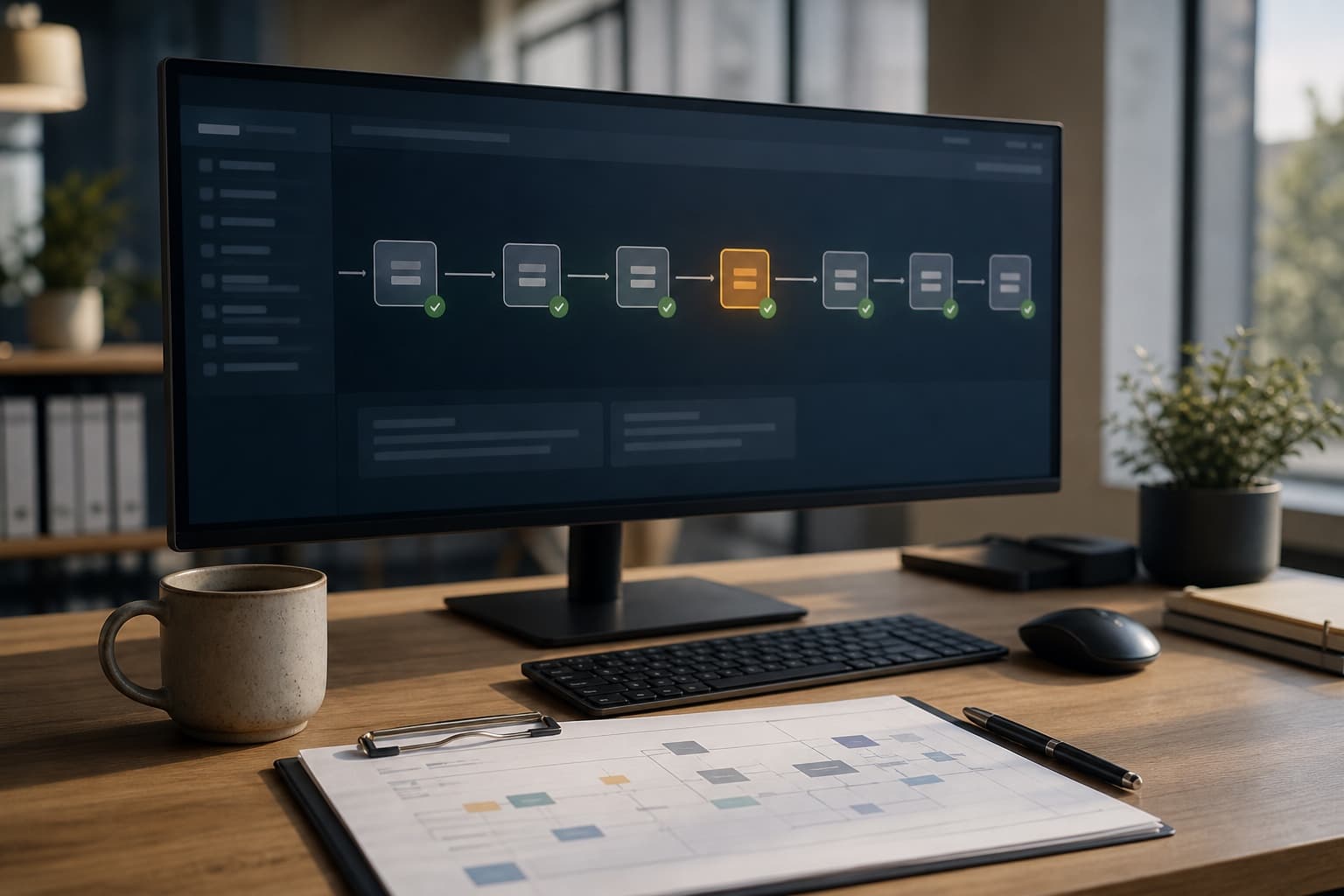
An operations desk running unattended: a monitor showing a workflow of connected steps, most cleared with a green check and one banded in amber, a printed process sheet on a clipboard beside the keyboard.
01

Governed AI Workflows

Connect people, systems, and AI agents into governed workflows that produce reliable, auditable business operations.

An auditor's hands turning the tabbed dividers of a thick ring binder of records, a rubber stamp and ink pad beside it, a shelf of sealed archive boxes softly blurred behind.
02

Workflow Compliance and Governance

Enforce policy in the process itself and let every run produce the audit-ready evidence your auditors and regulators ask for.

A hand marking a revision in pencil on a printed standard work procedure pinned to an operations board, a run chart with a rising trend line pinned beside it, a plant floor softly blurred behind.
03

Operational Excellence

Kora turns manual procedures into governed workflows your organization owns: AI agents run the routine path, people decide the exceptions, and every run is measured so the process keeps improving.

§ 07 · FAQ

Questions, answered.

Straight answers to what teams evaluating governed workflows ask: what Kora is, how it differs, where it runs, how data is handled, what it connects to, and how it is priced.

Kora is a workflow governance platform where people, AI agents, and systems execute business processes together inside agentic workflows the organization owns and controls. Every run executes under a released, governed version and leaves a detailed, replayable evidence record, hash-chained so a downstream system can sign and anchor it for audit.

Workflow governance means an organization controls how its business processes execute: who can change a process, which version runs, who approves exceptions, and what evidence each run leaves behind. It extends workflow automation with ownership, policy, and auditability.

An agentic workflow is a business process where AI agents, people, and systems execute the steps together toward an outcome, with each agent able to take actions, call tools, and make decisions inside the process. In Kora, agentic workflows run under a released, governed version, and every run leaves a detailed, replayable evidence record.

Kora treats the workflow itself as a governed asset, while automation tools focus on executing tasks. Your organization owns the process definition, controls releases, observes every run, and expands automation over time only where the run evidence supports it.

A process is described in conversation, and Kora compiles and validates that description into a versioned workflow definition, then presents the workflow graph as a read-only view to inspect. Teams can also author from an assistant they already work in, such as Claude or Codex, and every change still reaches production through release control.

Yes. AI agents work alongside people and systems in a workflow. Each agent runs on a model chosen from Kora's supported list, across providers you likely already use, including Anthropic's Claude and OpenAI's GPT models, plus Google, xAI, Groq, Mistral, DeepSeek, and more, with an operator supplying the provider API key per environment. Custom and self-hosted model endpoints are on the roadmap. Each agent runs under the released process version, acts only within the permissions granted to its step, and leaves a recorded, hash-chained trace for every action.

Kora runs on your own hardware. You install it with the Docker Compose deploy bundle and the koractl operator command, on-prem or air-gapped, so the runtime and every workflow run inside your environment. Kora Cloud does not run your workflows; it is the account, licensing, and instance-management service for connected deployments. A Kubernetes deployment target is on the roadmap and not yet shipped. Offline and air-gapped installs run fully disconnected.

Your workflows and their evidence records always run on your own hardware, on-prem or air-gapped, so workflow data stays inside your environment. Offline and air-gapped installs send nothing back. For connected deployments, Kora Cloud provides account, licensing, and instance management, and on non-Enterprise plans it also receives telemetry and data-contribution records described in the Terms and Privacy Notice; an Enterprise deployment sends only periodic license check-ins with advisory usage counts.

Yes. Kora's runtime always runs on infrastructure you control: your own hardware on-prem, a private or EU-sovereign cloud account, or a fully air-gapped install, so your workflows execute and their evidence records are produced in your own environment. Offline, air-gapped, and Enterprise deployments keep that data fully in your hands; connected non-Enterprise plans send only the telemetry and data-contribution records described in the Terms and Privacy Notice.

Kora connects to hundreds of prebuilt integrations across the enterprise stack, including Gmail, Outlook, Slack, Salesforce, HubSpot, Jira, GitHub, Snowflake, and Google Sheets. It also reaches internal APIs and databases through service operations that run governed code, extracts content from documents in a workflow step, connects to Streamable HTTP MCP endpoints, and can build a custom connector for your own stack. Every connector runs under the same scoped permissions as any other step, and its calls are recorded in the run evidence.

Every production run is captured as a durable, hash-verifiable record, tagged with its release, environment, and deployment, so the data is attributable to the version that produced it. Every change already ships through release control: immutable releases, controlled environment deployment, and audited rollback by redeploying an earlier release. Replaying a candidate version against those historical runs, and gating promotion on how it compares, is on the active roadmap and not yet enforced today.

That is the direction. Kora keeps cross-referenced evidence layers: a control-plane audit log of who changed what, plus runtime evidence, agent traces, and a journal of the workflow's business facts. The same captured run data an audit relies on is what an evaluation loop would later consume, so no extra instrumentation is needed. Using those records to backtest candidate versions, and to export governed datasets to a fine-tuning or reinforcement-learning provider you choose, is on the roadmap, not live today. Kora does not train models itself, and where that data lives follows your deployment.

Yes. Kora has a free tier you can start on your own without a sales call, plus paid plans: Pro, Teams priced per seat, and Enterprise. Every plan runs the same runtime, which enforces the limits and features your license carries. Pro lifts usage limits for a single user and organization, Teams adds seats and organizations, and Enterprise covers the largest deployments, including fully offline and air-gapped installs. Full details are on the pricing page.
§ 09 · Next step

One real process is enough.

In a demo, we take a process you run today, describe it in chat, run it under governance, and show the record it leaves: evidence for auditors, and the data that makes the next version better.